



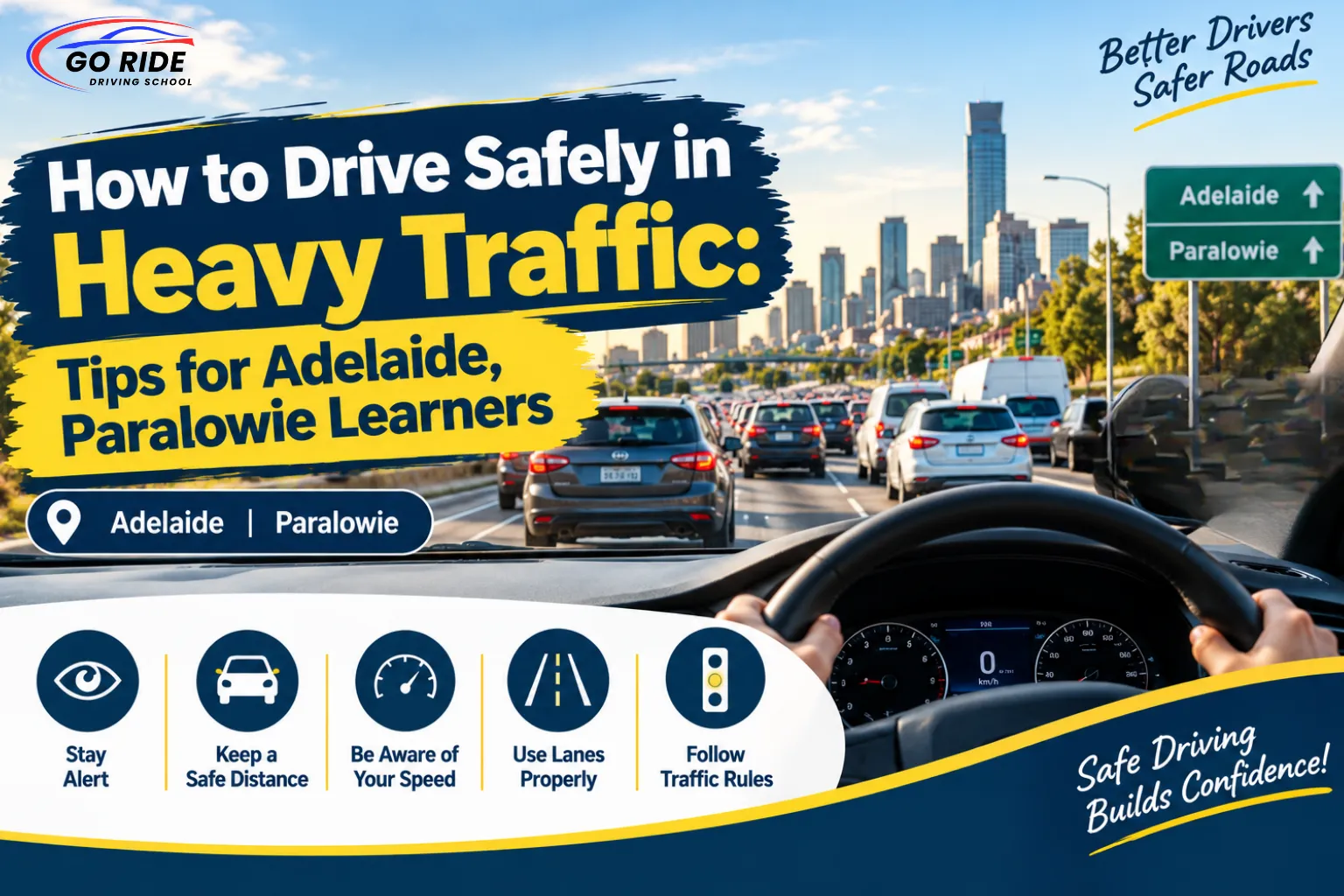
Driving in heavy traffic can feel stressful when you are still learning. Cars may stop suddenly, other drivers may change lanes, and busy intersections can require quick decisions. For learner drivers in Adelaide/Paralowie, these situations can be challenging at first, but with regular practice and the right driving habits, you can become a safer and more confident driver.
Whether you are driving around adelaide’s busy roads, approaching traffic lights, entering a roundabout, or practising lane changes, understanding how to drive safely in heavy traffic is an important part of learning to drive.
In this guide, we will share practical driving tips for learners to help you stay calm, maintain a safe distance, anticipate hazards, and make better decisions on the road.
Why Is Heavy Traffic Difficult for Learner Drivers?
Heavy traffic requires you to pay attention to several things at once. You need to monitor the vehicles around you, check your mirrors, follow road signs, maintain a safe speed, and prepare for sudden changes.
Some common challenges for learner drivers include:
- Keeping a safe distance from the vehicle in front.
- Starting and stopping smoothly in slow-moving traffic.
- Changing lanes safely when roads are busy.
- Approaching traffic lights and intersections.
- Handling impatient drivers without feeling pressured.
- Recognising hazards before they become dangerous.
The key is to remember that safe driving is more important than reaching your destination quickly. You do not need to rush or copy another driver’s behaviour to keep up with traffic.
1. Keep a Safe Distance from the Car in Front
One of the most important rules for driving in heavy traffic is maintaining a safe following distance.
When traffic is moving slowly, it may be tempting to drive close to the vehicle in front so that other cars cannot enter the gap. However, this reduces your reaction time if the vehicle suddenly brakes.
In good conditions, Western Australian road safety guidance recommends leaving at least a two-second gap between your vehicle and the vehicle ahead. Increase this distance when the road is wet or visibility is poor.
How to Maintain a Safe Following Distance
- Choose a fixed landmark, such as a road sign or power pole.
- Watch the vehicle in front pass the landmark.
- Count “one thousand and one, one thousand and two”.
- Make sure your vehicle does not reach the landmark before you finish counting.
- Leave more space when conditions require it.
Remember, a safe gap is not wasted road space. It gives you more time to react and brake smoothly.
2. Stay Calm When Traffic Moves Slowly
Stop-start traffic can be frustrating, especially when you are worried about making mistakes. However, becoming impatient can lead to poor decisions.
When traffic slows down, avoid sudden acceleration, harsh braking, or unnecessary lane changes. Instead, focus on the movement of traffic ahead and make gradual adjustments to your speed.
If another driver sounds their horn or tries to pressure you, do not panic. Continue driving safely and follow the road rules.
Tip for Adelaide learners: During your early practice sessions, start on quieter roads before progressing to busier routes. Build your confidence gradually rather than forcing yourself into difficult situations too soon.
3. Look Ahead and Anticipate Traffic Changes
Looking only at the car directly in front of you makes it harder to prepare for sudden changes.
Develop the habit of scanning further ahead whenever it is safe to do so. Look for brake lights, traffic signals, pedestrian crossings, intersections, merging vehicles, and queues forming on the road.
For example, if you notice several cars braking ahead, ease off the accelerator early instead of waiting until the vehicle in front stops.
This approach can help you avoid harsh braking, maintain a smoother driving style, and identify potential hazards earlier.
Also, keep checking your mirrors to understand what is happening behind you. Remember to maintain your attention on the road and avoid staring at any one vehicle for too long.
4. Change Lanes Only When It Is Safe
Changing lanes in heavy traffic can be difficult because gaps may be smaller and other vehicles may move unexpectedly.
Before changing lanes, follow a consistent routine:
- Check your mirrors to assess surrounding traffic.
- Signal in advance to communicate your intention.
- Check your blind spot by looking over your shoulder.
- Confirm that there is enough space to move safely.
- Change lanes smoothly without cutting off another vehicle.
Never assume another driver will slow down to let you in. If there is no safe gap, remain in your lane and wait for a suitable opportunity.
You should also avoid crossing continuous lane lines when changing lanes. Follow the road markings and signs, and never make a sudden manoeuvre simply because you are approaching your turn.
5. Approach Traffic Lights and Intersections Carefully
Busy intersections can be confusing for learner drivers because several vehicles may be turning, crossing, or changing lanes at the same time.
As you approach an intersection, reduce your speed when appropriate and check the traffic signals, road signs, lane markings, pedestrians, and cyclists.
Keep these tips in mind:
- Choose the correct lane early.
- Follow traffic lights and give way rules.
- Watch for pedestrians crossing the road.
- Avoid entering an intersection unless there is enough space to clear it safely.
- Do not rush through an amber light if it is safe to stop.
- Check carefully before turning, even when the traffic signal permits your movement.
When approaching a roundabout, reduce your speed, observe the signs and road markings, give way as required, and watch for cyclists and other road users.
Practising these situations with a qualified driving instructor in Adelaide/Paralowie can help you understand how to respond safely when several things happen at once.
6. Practise Merging on Busy Roads
Merging is another skill that can make learner drivers nervous, particularly when entering a busy road or freeway.
The safest approach is to plan ahead, observe the traffic, signal as required, and adjust your speed to fit into a suitable gap without exceeding the speed limit.
Before merging:
- Check the road ahead and the traffic around you.
- Use your mirrors and check your blind spot.
- Signal to show your intention.
- Adjust your speed appropriately.
- Enter the traffic flow only when there is a safe gap.
Do not stop unnecessarily in a merging lane if traffic conditions allow you to continue safely. At the same time, never force your way into a gap that is too small.
If you miss your intended turn or exit, stay calm and continue to a safe alternative route. Never make a sudden lane change to avoid missing a turn.
7. Watch for Motorcycles, Cyclists and Pedestrians
Heavy traffic is not just about watching cars. Motorcycles, cyclists, pedestrians, and other road users can be harder to notice when the road is busy.
Check your mirrors and blind spots before turning or changing lanes. Be particularly careful near intersections, parked vehicles, pedestrian crossings, and areas where cyclists may be travelling alongside traffic.
When turning, look for pedestrians who may be crossing the road. Always follow the applicable give-way rules and traffic signals.
A useful habit is to ask yourself: “What could happen next, and where should I look?”
Thinking ahead helps you identify possible hazards before they become emergencies.
8. Avoid Distractions and Focus on Driving
Heavy traffic requires your full attention. Even a brief distraction can cause you to miss a vehicle braking, a changing traffic signal, or a pedestrian entering the road.
Before starting your lesson or journey:
- Set your mirrors and seat position.
- Enter your destination into navigation before moving.
- Put your phone away and avoid handling it while driving.
- Adjust the temperature, music, and other controls before you begin.
- Ask passengers to keep conversations manageable if you need to concentrate.
Learner drivers should focus on developing safe habits rather than trying to multitask. If you feel overwhelmed, concentrate on controlling the vehicle, observing the road, and making one safe decision at a time.
9. Practise Driving in Different Traffic Conditions
You cannot become confident in heavy traffic simply by reading driving tips. You need supervised practice in different situations.
Western Australia’s Department of Transport recommends progressing from low-traffic environments to more complex driving conditions as your skills develop.
A useful progression for Adelaide,paralowie learners is:
Stage 1: Quiet streets
Practise steering, smooth braking, speed control, mirror checks, and basic intersections.
Stage 2: Moderate traffic
Practise following distances, traffic lights, roundabouts, and responding to other vehicles.
Stage 3: Busy roads
With appropriate supervision, practise lane changes, merging, and navigating more complex intersections.
Stage 4: More challenging conditions
When you are ready, practise driving during busier periods and in different weather and lighting conditions.
You might gradually practise on suitable roads around your local area before progressing to more demanding routes. The important thing is to choose conditions that match your current ability and increase the difficulty as your confidence grows.
10. Learn with a Qualified Driving Instructor
Learning from an experienced driving instructor can help you identify mistakes, improve your decision-making, and develop safer driving habits.
Professional driving lessons can help you practise busy intersections, merging situations, lane changes, and stop-start traffic while explaining what to look for and how to respond.
At Go Ride Driving School, learners can build their driving skills through personalised lessons designed to support safer driving and greater confidence.
If you are a learner driver who feels nervous about busy roads, consider discussing your concerns with your instructor. You can work together on a practical plan that starts with your current skill level and progresses at a comfortable pace.
Visit Go Ride Driving School to explore available driving lessons.
Common Mistakes Learner Drivers Should Avoid in Heavy Traffic
Even a small mistake can make a busy road more difficult to manage. Watch out for these common problems:
| Common mistake | What to do instead |
| Following too closely | Maintain a safe gap and increase it when conditions are poor. |
| Braking suddenly | Look further ahead and slow down gradually when possible. |
| Changing lanes without checking blind spots | Check mirrors, signal, and check your blind spot before moving. |
| Feeling pressured by other drivers | Stay calm and make safe, legal decisions. |
| Looking only at the car in front | Scan ahead and monitor your surroundings. |
| Rushing through intersections | Observe signals, signs, pedestrians, and give-way rules. |
| Using a phone while driving | Put distractions away and keep your attention on the road. |
Frequently Asked Questions
How can learner drivers stay safe in heavy traffic?
Learner drivers can stay safer by maintaining a suitable following distance, looking ahead, checking mirrors and blind spots, signalling before manoeuvres, obeying road signs, and avoiding distractions. Practise in progressively busier conditions with a qualified instructor or appropriate supervising driver.
What is the safest following distance in heavy traffic?
In good conditions, WA road safety guidance recommends at least a two-second gap behind the vehicle in front. You should increase the gap in wet weather, poor visibility, or other conditions that affect stopping distance. In stop-start traffic, avoid creeping too close to the vehicle ahead.
How can I overcome my fear of driving in heavy traffic?
Start with quiet roads and gradually practise more challenging situations as your skills improve. Learn one skill at a time, such as smooth braking or checking blind spots. A calm instructor and regular supervised practice can help you build confidence without rushing your progress.
Is it safe for learner drivers to practise on busy Adelaide,Paralowie roads?
Yes, learner drivers can practise in a range of traffic conditions when they are ready and have appropriate supervision. Start with easier routes and progress to busier roads as your ability improves. Learner drivers in Western Australia must follow the applicable learner licence conditions, including driving with a qualified supervising driver.
What should I do if another driver is tailgating me?
Stay calm, avoid sudden braking, and continue driving safely at an appropriate speed. Do not speed up beyond the limit or make risky manoeuvres to get away. Maintain awareness of the traffic ahead and, when it is safe and appropriate, allow the other driver to pass.
How can driving lessons help me handle heavy traffic?
Professional driving lessons can help you practise hazard awareness, safe following distances, lane changes, merging, intersection decisions, and speed control. An instructor can explain what you need to improve and help you progress towards more complex driving conditions.
Final Thoughts
Driving safely in heavy traffic takes practice, patience, and good decision-making. By keeping a safe distance, looking ahead, changing lanes carefully, and remaining calm under pressure, you can gradually become a more confident learner driver.
Remember that you do not need to master every situation immediately. Focus on building strong habits, practising under appropriate supervision, and learning from your mistakes.
If you are learning to drive and want to feel more comfortable on busy roads, Go Ride Driving School can be a starting point for developing your driving skills and confidence.
Ready to improve your driving confidence? Visit Go Ride Driving School to learn more about available lessons.